The Best Time of Year to Pour Concrete in Washington
If you are planning a new driveway, patio, or walkway, timing matters more than most homeowners expect. The best time to pour concrete in Washington is not just about your schedule. It is about giving the concrete the temperature and dry conditions it needs to cure into a strong, long-lasting surface. Pour at the wrong time of year and you risk a weaker slab, surface flaking, and repairs that show up years earlier than they should.
In western Washington, and especially on the Kitsap Peninsula around Silverdale, the calendar plays a bigger role than it does in drier parts of the country. Our wet winters and short, dry summers create a fairly narrow window when conditions are close to ideal. This guide walks through how temperature and moisture affect your pour, which months tend to work best here, what a winter pour really involves, and how to plan so your project lands at the right time. Whether you are budgeting for a new concrete driveway installation and repair project or adding an outdoor living space, understanding the seasons will help you get a better result.
Why Timing Affects Concrete Quality
Concrete does not simply dry. It cures through a chemical reaction called hydration, where cement and water react and harden over time. That reaction is sensitive to temperature. When conditions are too cold, hydration slows down and the concrete gains strength more slowly, which leaves it vulnerable during the first critical days. When conditions are too hot, the mix can lose water too fast, which also weakens the finished slab and can cause cracking.
Industry guidance from the American Concrete Institute points to a comfortable target range of roughly 50 to 60 degrees Fahrenheit for pouring and early curing. Below about 40 degrees, the reaction slows sharply. If fresh concrete freezes before it has gained enough early strength, the water inside expands and can damage the internal structure, cutting strength significantly and shortening the lifespan of the slab.
This is why the season you choose is not a small detail. The same driveway poured in July and poured in January can end up with very different long-term durability, even with the same crew and the same mix. Getting the timing right is one of the simplest ways to protect your investment.
The Ideal Temperature Range for Pouring Concrete
The sweet spot for pouring and curing concrete sits between about 50 and 60 degrees Fahrenheit for both the air and the mix. In that range, hydration moves at a steady pace, the surface finishes cleanly, and the slab builds strength the way it should.
Here is a simple way to think about how temperature affects a pour:
| Temperature Range | What It Means for Your Pour |
|---|---|
| Below 40 F | Hydration nearly stalls. Freezing risk is high. Needs blankets, heaters, or accelerators. |
| 40 F to 50 F | Workable with precautions. Curing is slow and protection is required for the first days. |
| 50 F to 60 F | Ideal. Steady curing and strong finished slab. |
| 60 F to 80 F | Good, with attention to moisture loss on the warmer, windier days. |
| Above 90 F | Too hot. Water evaporates fast, raising the risk of shrinkage cracks and a weak surface. |
Nighttime temperatures matter too. A mild afternoon does not help much if the temperature drops near freezing overnight while the concrete is still young. That overnight swing is one of the reasons the shoulder seasons, early spring and late fall, require more care here than the middle of summer.
Washington's Climate and What It Means for Concrete
Western Washington has a reputation for rain, but the pattern is more specific than most people assume. Around Silverdale and the wider Kitsap Peninsula, the climate is mild rather than extreme. Summers are short, warm, and dry, while winters are cool and wet rather than deeply frozen. Hard freezes happen, but snow in the lowlands is uncommon.
The bigger challenge here is not cold. It is water. The region receives the vast majority of its rain from late fall through early spring, with the wettest stretch centered on November through January. July, by contrast, is remarkably dry, often seeing under half an inch of rain across the whole month. That dry summer window is what makes the warm months so valuable for concrete work.
Here is how the seasons generally break down for pouring concrete in the Silverdale area:
| Season | Typical Weather | Pouring Outlook |
|---|---|---|
| Spring (Mar-May) | Cool and damp, warming up | Improving by late spring. Early spring still risks rain and cold nights. |
| Summer (Jun-Sep) | Warm and dry, low rainfall | Best window of the year. Ideal temps and very little rain. Books up fast. |
| Fall (Oct-Nov) | Cooling, rain returns | Early fall is still good. Late fall turns wet and cold quickly. |
| Winter (Dec-Feb) | Cool and wet, occasional frost | Toughest window. Possible with protection and careful scheduling, but not ideal. |
The takeaway is straightforward. In our climate the enemy is usually moisture and cool, unpredictable shoulder seasons, not deep winter freezes. That shapes when a smart homeowner schedules a pour.
The Best Months to Pour Concrete in Washington
For most residential projects around Silverdale, the strongest window runs from late spring through early fall, roughly late May through September. During these months daytime temperatures usually land in or near the ideal range, overnight lows stay well above freezing, and rainfall drops to its lowest point of the year. That combination gives concrete the warm, dry, stable conditions it needs to cure properly.
Midsummer, from roughly mid-June through September, is the most reliable stretch. This is when the region finally settles into its dry season, and it is the safest time to schedule outdoor flatwork like driveways, walkways, and a new concrete patios and designs project. If your goal is the cleanest finish and the lowest weather risk, this is the window to aim for.
Early fall, through about mid-October, is often still an excellent time to pour. The ground is warm from summer, days are mild, and the heavy rains have not fully arrived. After that, conditions shift quickly, and by November the wet season is in full swing.
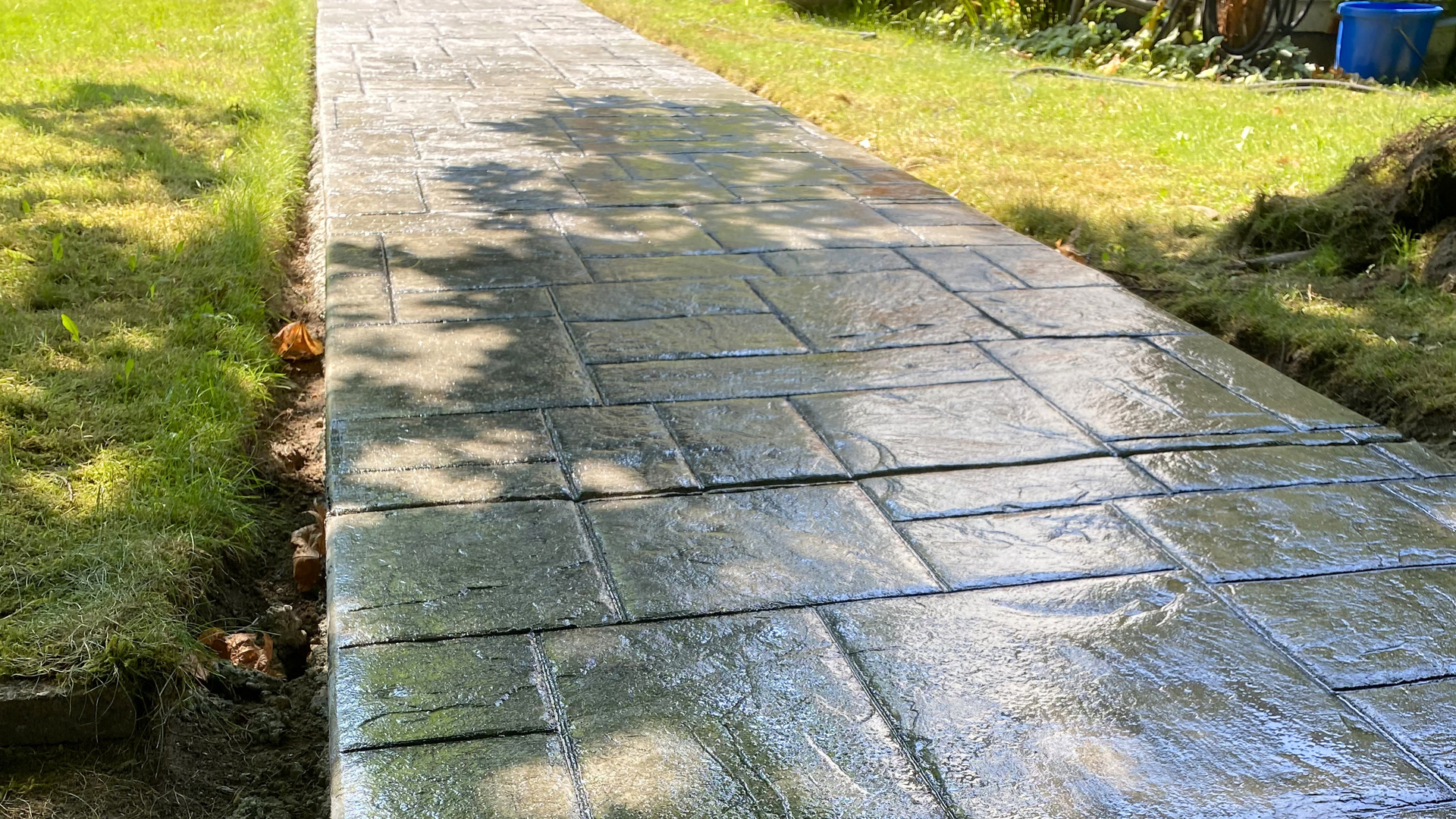
One practical consequence of this short ideal window is demand. Because summer offers the best conditions, most homeowners want their projects done then, and schedules fill up. Decorative work such as a stamped and colored concrete finish is especially popular in the warm months, so calendars can book weeks out. Planning early is the difference between pouring in your ideal window and waiting until conditions are working against you.

Can You Pour Concrete in Winter in Washington?
Yes, concrete can be poured in the colder months, and experienced crews do it when a project calls for it. The key is understanding what winter pouring actually requires so you can decide whether it is worth it for your project.
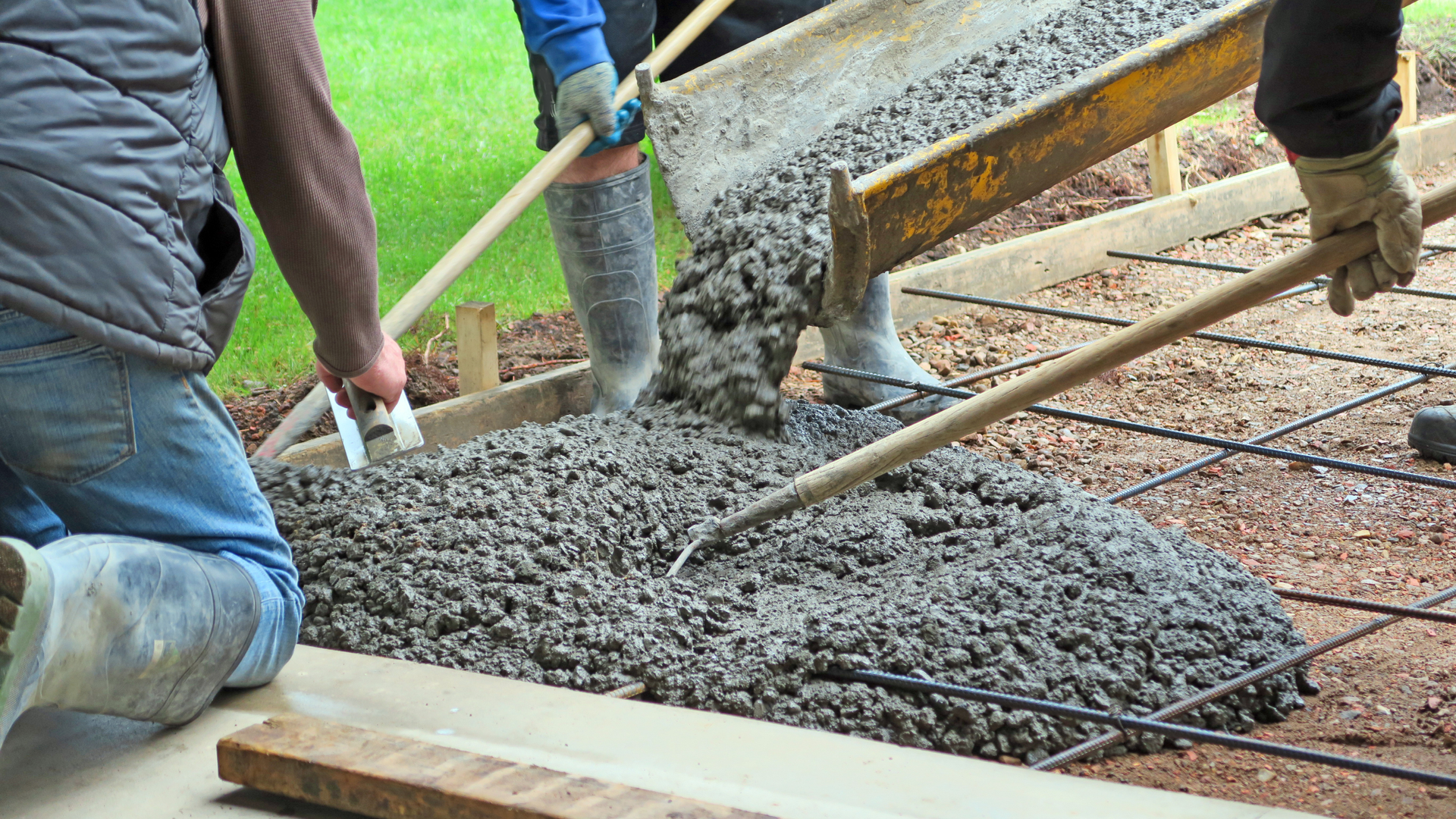
Because western Washington winters are wet and cool rather than deeply frozen, the main hurdles are rain, short daylight, and near-freezing overnight lows during the early curing period. To pour successfully in these conditions, a crew
may use several tools:
- Insulated curing blankets to hold heat in the slab and keep it above freezing.
- Set accelerators or adjusted mixes that speed early strength gain.
- Careful forecast tracking to place concrete between rain events.
- Ground preparation that avoids pouring on frozen or saturated subgrade.
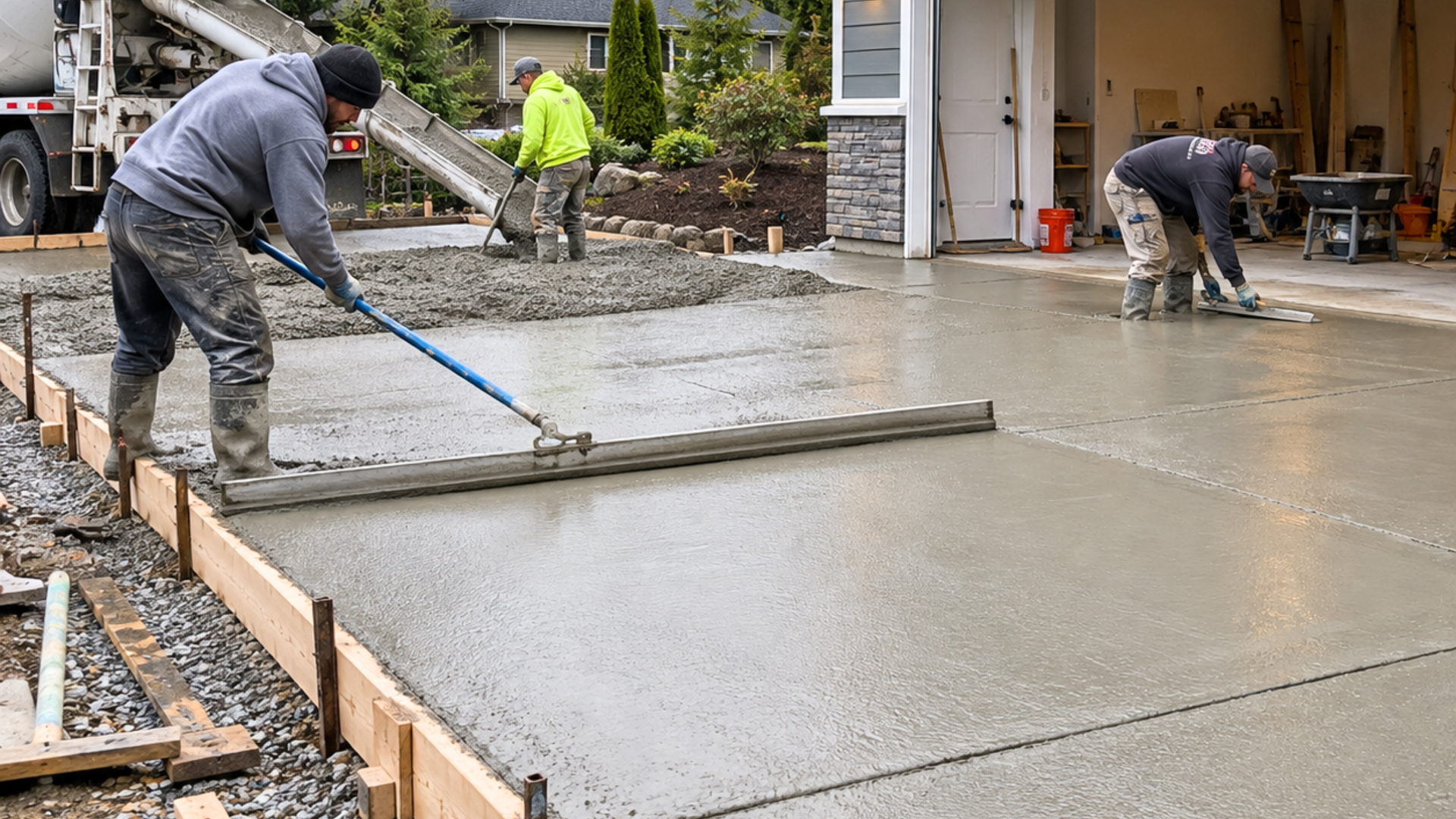
These steps work, but they add cost, complexity, and scheduling uncertainty. A pour that would be routine in July becomes a more managed operation in January. For time-sensitive repairs or commercial needs, that tradeoff can make sense. For a homeowner with flexibility, it is usually better to wait for a friendlier window. If you want a closer look at what happens on site during a pour, our guide to the concrete driveway installation process in Silverdale WA walks through each stage.
The Real Risk in Our Climate: Rain and Moisture
In many parts of the country, the timing conversation is all about frost. Here, rain deserves equal attention. Fresh concrete is vulnerable to water before it has set. Heavy rain landing on a slab that is still soft can wash cement from the surface, dilute the top layer, and leave a weak, dusty finish that scales and flakes in later years.
This is why the wet season, roughly November through March, is the trickiest time to pour in the Silverdale area. It is not that the temperature is impossible. It is that the odds of catching a bad rain window during placement or early curing go up sharply. A single poorly timed downpour can undo an otherwise solid pour.
Good crews manage this by watching the forecast closely, timing placement between systems, and covering fresh concrete when needed. But the simplest protection is seasonal. Pouring in the dry months removes most of this risk before it starts, which is a large part of why summer is the preferred window here.
How Timing Affects Long-Term Durability
The conditions during those first days of curing echo for the entire life of the slab. Concrete that cures in warm, dry, stable weather develops strong, dense surfaces that hold up well against wear, moisture, and the freeze-thaw cycles that come each winter. Concrete rushed in during cold or wet conditions, without the right protection, is more prone to early scaling, surface flaking, and cracking.
That difference compounds over time. A driveway poured under ideal summer conditions can deliver decades of service, while a poorly timed pour may show wear far sooner. If you want a sense of what to expect from a well-built slab in our climate, see our breakdown of how long a concrete driveway lasts in Silverdale WA. Timing your pour well is one of the clearest ways to land on the long end of that range.
Common Timing Mistakes Homeowners Make
A few avoidable missteps come up again and again when homeowners plan concrete projects in Washington:
- Waiting too long to book. By the time the weather is perfect, the best crews are already scheduled out. Deciding in July often means pouring in September.
- Squeezing a pour into a wet-season gap. A dry day in December does not guarantee dry days during the full curing window that follows.
- Ignoring overnight lows. Watching only the daytime high while nights dip toward freezing can compromise a young slab.
- Rushing a decision on cost alone. Timing affects durability, so the cheapest available slot is not always the best value.
- Skipping the forecast conversation. A good contractor will talk timing openly. If timing never comes up, that is a warning sign.
Avoiding these is mostly about planning ahead and working with a crew that treats timing as part of the job rather than an afterthought.
How to Plan Your Concrete Project Around the Seasons
The best results come from working backward from your ideal pour window. If you want your concrete placed during the dry summer months, the planning should start well before then. Estimates, site visits, scheduling, and any demolition or prep all take time, and the calendar tightens as summer approaches.
A simple planning rhythm looks like this. Reach out for an estimate in late winter or early spring, lock in your scope and schedule through spring, and pour during the dry summer window. That sequence puts your project in the best conditions and avoids the last-minute scramble for a good weather slot.
Budget planning fits naturally into this timeline too. Knowing your numbers early makes it easier to commit to a date. Our guide to concrete driveway replacement cost in Washington is a useful starting point if you are weighing a new pour against your budget. With the cost and the calendar sorted early, you are free to target the window that gives your concrete the best possible start.
Frequently Asked Questions
What is the best time of year to pour concrete in Washington?
For most of western Washington, including Silverdale, the best window runs from late spring through early fall, roughly May through September, when temperatures are mild and rainfall is at its lowest.
What temperature is best for pouring concrete?
Concrete cures best when the air and mix stay between about 50 and 60 degrees Fahrenheit. Below 40 degrees the reaction slows sharply, and above about 90 degrees the mix can dry out too fast.
Can you pour concrete in winter in Washington?
Yes, but it requires insulated blankets, adjusted mixes, and careful timing around rain and freezing nights. It is workable with an experienced crew, though it is not the ideal window.
Does rain ruin freshly poured concrete?
Heavy rain before the surface has set can weaken the top layer and cause scaling later. That is a bigger seasonal risk here than freezing, which is why the dry summer months are preferred.
Why do contractors book up in summer?
Summer offers the best conditions, so most homeowners schedule then, and calendars fill quickly. Planning several weeks ahead helps you secure your ideal window.
Plan Your Pour With Pacific Roots Concrete
The best time to pour concrete in Washington comes down to giving your slab warm, dry, stable conditions, and in the Silverdale area that means aiming for the late-spring-through-early-fall window while planning ahead so you are not boxed into a wet or cold slot. Get the timing right and you set your driveway, patio, or walkway up for decades of durable service. And once your concrete is in, a little routine care goes a long way, as we cover in our concrete driveway maintenance tips for Silverdale homeowners.
If you are thinking about a project this year, now is the time to start the conversation so you can lock in the right window. request a free estimate from our team and we will help you plan the scope, the budget, and the ideal timing for a result that lasts. Reach out to Pacific Roots Concrete to talk through your project today.